
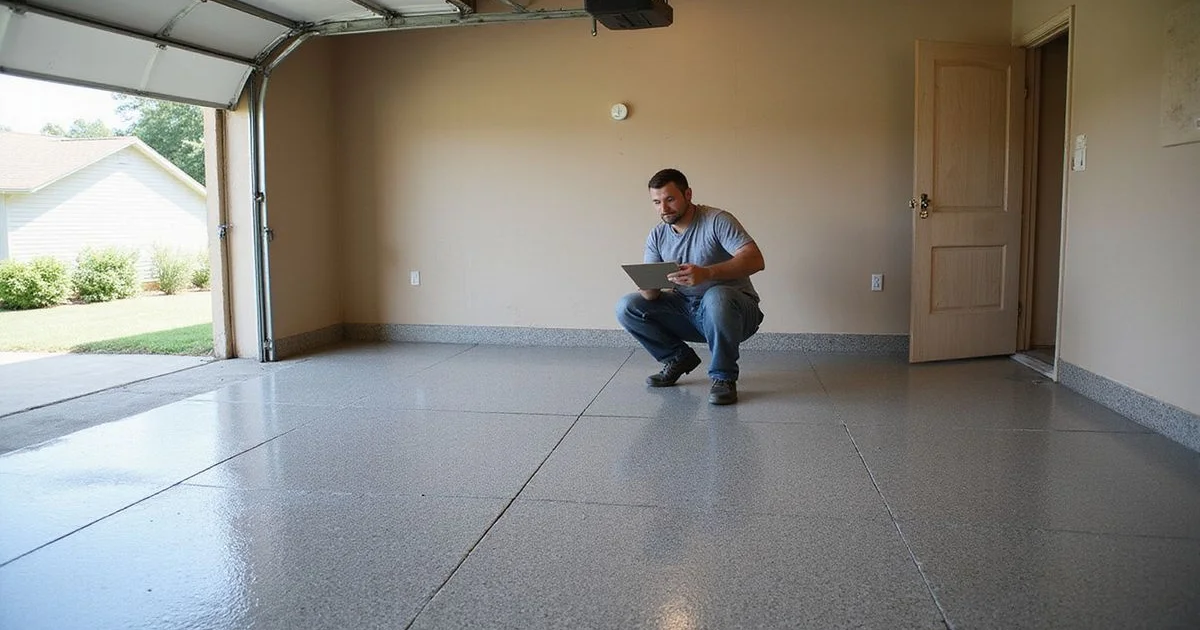
The Decision Behind a Failing Floor
Deciding on an epoxy floor repair vs recoat strategy is a stressful choice for facility managers and homeowners. Our team sees this constant cycle of surface failure across properties every week. The reality is that inadequate surface preparation causes roughly 80% of all early coating breakdowns.
This statistic is the reason why a cheap patch often fails again. Fixing the problem requires a hard look at the concrete surface profile beneath the peeling paint. We use a specific diagnostic framework on every epoxy repair job to determine the true cause of the damage.
Let’s look at the actual data driving these failures and outline the exact steps to choose the right fix.
Repair, Recoat, or Redo: The Three Options
Every failing floor requires a concrete answer within the first few minutes of inspection. We categorize the solutions into three distinct paths based on the severity of the damage. A spot fix, a complete topcoat, or a ground-up rebuild are your only true choices.
The specific options look like this:
- Repair localized damage: This involves filling specific cracks or spalled areas. Our crews often use polyurea fillers that cure in just 15 minutes to fix isolated spots. The rest of the floor stays exactly as it is.
- Recoat the whole floor: This method restores the surface protection when the underlying base is still bonding perfectly. We apply a high-build topcoat that adds 10 to 30 mils of fresh thickness. Standard DIY paints are only 2 to 4 mils thick, so this professional layer provides immense durability.
- Remove and redo completely: This process grinds the failed coating off to rebuild from the slab up. Our technicians use heavy diamond grinders to achieve a proper Concrete Surface Profile of 3 or 4. This rough texture is mandatory for a new base coat to lock in.
The correct choice always depends on the damage extent and the original cause of failure.
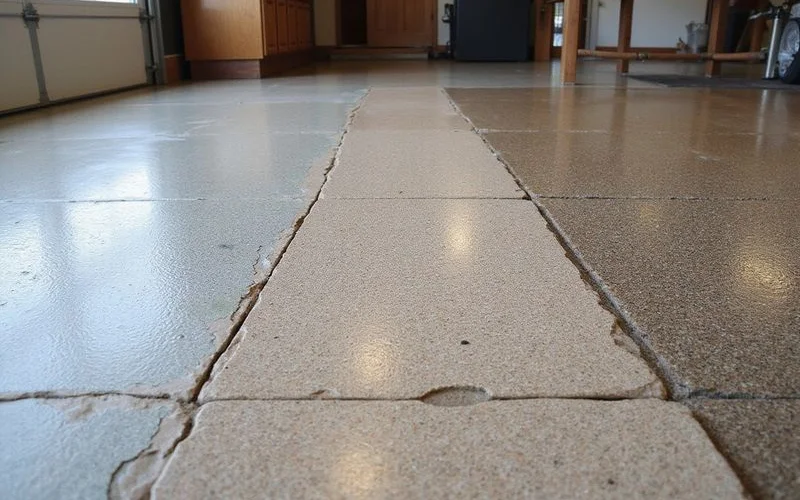
The Damage Thresholds
Evaluating the floor requires clear metrics rather than simple guesswork. We rely on strict industry thresholds to determine if a floor can be saved or if it requires a total tear-out.
Visual and Structural Triggers
The percentage of peeling coating is the first major red flag. We draw a hard line at the 25% mark for localized patching. Once more than a quarter of the floor has delaminated, a complete removal is the only viable path.
Here is the framework for making that call:
| Situation | Right call |
|---|---|
| Minor, localized damage; sound base | Repair |
| Worn or dull surface; base still bonded | Recoat |
| More than ~25% delaminated | Remove and redo |
| Root cause is moisture (MVT) | Remove and redo |
| Base coat itself is failing | Remove and redo |
The Moisture Factor
Moisture Vapor Transmission is the silent killer of resin floors. We always perform testing because water vapor pushing up from the soil will destroy even the thickest epoxy.
The standard ASTM F1869 calcium chloride test provides a clear scientific answer. Our limit for a standard installation is 3 pounds of moisture per 1,000 square feet over 24 hours. Anything higher than that number requires a specialized moisture vapor barrier primer before any color coats are applied.
Why patching a moisture failure is a bad idea
If moisture vapor from the slab caused the initial bubbling, patching the surface just traps the problem again. The water pressure will simply move to the next weakest spot and blow the coating off. The only honest fix is a full redo with a proper vapor barrier. We will tell you that immediately, even though it requires significantly more work and budget.
The Cost Comparison
Financial realities often push property owners toward the smallest possible invoice. We see this play out constantly when comparing a quick fix to a full replacement. A spot repair might only cost a few hundred dollars today.
The math changes dramatically when you look at a two-year timeline. Our current 2026 data shows a professional recoat averages $3 to $7 per square foot. A full removal and redo for a typical two-car garage runs between $5,200 and $8,400 depending on the concrete condition.
To understand the real financial impact, consider these baseline replacement costs:
- Minor Patching: Often under $1,000, but rarely addresses systemic issues.
- Professional Recoat: Costs $3 to $7 per square foot and requires a completely stable base.
- Full Removal and Redo: Averages $5,200 to $8,400 for a standard commercial bay or residential garage.
On paper, a small patch always wins the initial bidding war. The trap is that spending $800 on a repair for a floor that actually needed a redo is completely wasted capital. You are essentially making a down payment on a full replacement you will still have to buy next year.
A repair that holds is a fantastic value for your property. A repair that peels up from hot tire pickup six months later is a financial disaster.
Hidden Expenses of Failure
Failing to fix the root cause generates massive hidden expenses. We factor in the cost of heavy mechanical grinding just to remove the botched DIY repair. Professional removal alone can add $3 to $5 per square foot to the total project before any new material goes down.
Choosing the right option the first time prevents this wasteful cycle.
Lifespan and the Honest Recommendation
A full remove-and-redo restores the floor to peak condition and typically guarantees a 15 to 25-year lifespan for a high-quality 100% solids epoxy. A written workmanship guarantee applies to these ground-up rebuilds because they are effectively brand new installations.
A topcoat extension adds several years of life to an already sound system. A spot patch simply buys you a little time in a specific traffic zone.
The Diagnostic Approach
Our approach starts with a rigorous diagnostic process to find the actual failure point. You can read about how we identify these symptoms in our guide on common problems to understand the structural signs.
The recommendation you get from us will be the exact solution that solves the chemical or structural issue. Sometimes a cheap repair is genuinely all you need. Other times, the moisture levels demand a full removal.
Either way, you receive a completely honest, data-driven answer. We refuse to sell you a fast fix that will fail before the year is over.
Your Next Steps for a Stronger Floor
Understanding the difference between an epoxy floor repair vs recoat is the secret to a long-lasting surface. The data clearly shows that taking shortcuts with concrete surface preparation or moisture testing will guarantee future failures.
Start by examining the peeling sections of your floor and looking for early signs of moisture.
If you need a professional assessment, reach out to a local epoxy floor restoration expert to schedule a concrete moisture test today.
Questions about your floor?
Real numbers, no pressure — transparent pricing on every system.