
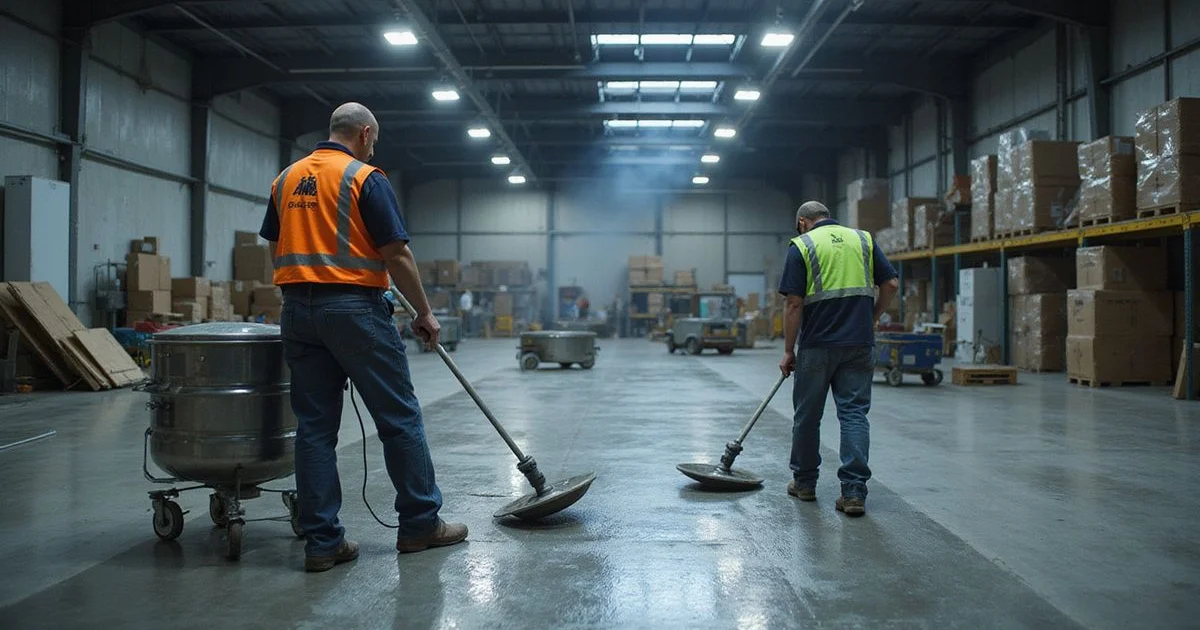
The Real Cost of a Commercial Floor
Operations managers know the actual price tag of a facility upgrade is rarely found on the contractor’s estimate. We see this directly across the US market every single day. Recent 2026 industry data shows mid-sized manufacturing downtime costs between $22,000 and $50,000 per hour.
A single day of an offline warehouse or a closed restaurant quickly becomes an unacceptable financial loss.
Our team builds downtime minimization directly into how we plan every commercial epoxy project. The simple truth is that upgrading a facility surface almost never requires a total operational shutdown. We rely on three specific strategies, including after-hours scheduling, phased zones, and rapid-cure chemistry, to keep your doors open.
After-Hours and Weekend Scheduling
Shifting the installation timeline to match your closed hours is the most direct way to eliminate revenue disruption. We utilize overnight windows, weekend blocks, and scheduled holiday closures as standard operating procedure. A busy commercial kitchen closing at 10 PM can receive a fresh coat overnight and resume prep at 6 AM without missing a breakfast service.
Our crews adapt to the hours your operation does not use. Scheduling flexible application times prevents lost foot traffic and keeps daily quotas intact. We execute these off-hours installations across several facility types:
- Restaurants and Kitchens: Prep areas shut down late in the evening and return to full service by the next morning shift.
- Retail Storefronts: Installations begin Saturday night and cure completely before Monday morning shoppers arrive.
- Office Environments: Application happens overnight while the building is empty to prevent fume disruption.
The final result is a professional grade floor with zero impact on your standard business hours. We treat the word “downtime” simply as the hours your business is already asleep.
Phased Installs for Facilities That Never Close
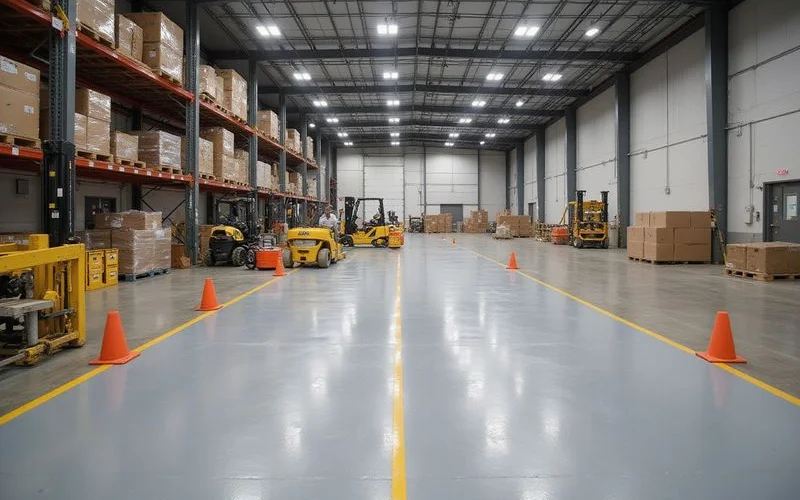
Large distribution centers and 24-hour manufacturing plants cannot afford to go completely dark for days. We solve this logistical challenge through a systematic phased installation process. Shutting down a massive operation costs money, and a 2026 AlphaCIS report highlights that even partial IT or facility outages can ripple through supply chains instantly.
The most effective workaround involves dividing the floor plan into manageable operational zones. Our technicians isolate one specific zone with physical barriers while the remaining square footage continues standard operations. Forklifts and personnel simply route around the active work area. We coat the isolated section, allow it to cure, and then transition the physical barriers to the next scheduled zone.
Phased install, in one line
Coat one zone while the rest of the floor keeps running. The facility never goes fully dark, it just shifts around a moving work area.
The building never experiences a full operational stop during this rolling installation. Our schedule might stretch longer on the calendar, but your daily shipping quota remains unaffected. Strict safety protocols demand clear separation, so physical barriers keep dust away from active inventory. We make sure the facility works effectively around a continuously moving section.
Fast-Cure Systems and Downtime by System
The chemical makeup of the coating itself acts as the third major lever for controlling downtime. We select specific polymer systems that match your required return-to-service timeline. Traditional resin formulas take nearly a week to fully harden, which is impossible for a high-traffic US loading dock.
Modern technology offers alternatives that cure in a fraction of that time. Our teams review data continually, noting that different base systems return to service on drastically different schedules:
| System | Return to service | Best application |
|---|---|---|
| Methyl Methacrylate (MMA) | 1 to 2 hours | Freezers and rapid turnarounds |
| Polyaspartic coatings | 4 to 24 hours | High-traffic zones and UV exposure |
| 100% solids epoxy | 3 to 7 days | Standard warehouses and basecoats |
| Urethane cement | 2 to 4 days | Areas prone to thermal shock |
Installers frequently deploy a polyaspartic same-day system when a commercial space must reopen the very next morning. We recommend polyaspartic technology because it cures up to four times faster than standard materials while offering excellent resistance to UV fading. Extreme environments require even faster solutions, making Methyl Methacrylate (MMA) highly valuable. Our crews use MMA formulations precisely because they cure in just 60 to 120 minutes, even in sub-zero freezer conditions down to -20°F.
Areas without intense time pressures still benefit from standard, cost-effective epoxy resins. We often use both extremes within a single building. Fast-cure chemistry works perfectly for the high-pressure zones, while standard systems provide excellent coverage elsewhere.
Planning Your Project
Every successful commercial floor installation starts with a thorough facility assessment. We conduct an on-site walkthrough to map out your precise operating hours and daily traffic patterns. A proper plan identifies which zones are absolutely critical and which areas can afford a longer curing window.
The surface condition must be evaluated closely to determine if extensive mechanical grinding is needed. Our estimators factor this required concrete surface preparation directly into the project timeline. Standard concrete surface profile requirements mean preparation often dictates the pace of the job. We use specific checkpoints to build an accurate schedule:
- Traffic Mapping: Identifying heavy forklift routes and critical access points.
- Moisture Testing: Finding potential vapor issues that might cause future peeling.
- Chemistry Selection: Matching fast-cure or standard resins to specific zone requirements.
A clear roadmap dictates exactly what happens after hours, what gets phased, and where rapid-curing chemistry is strictly required. We ensure the final result is a highly durable commercial surface achieved with disruption measured in hours instead of weeks.
Book a free on-site assessment today, and tell us exactly how your operation runs. We are ready to help your facility stay productive during your next upgrade.
Questions about your floor?
Real numbers, no pressure — transparent pricing on every system.