
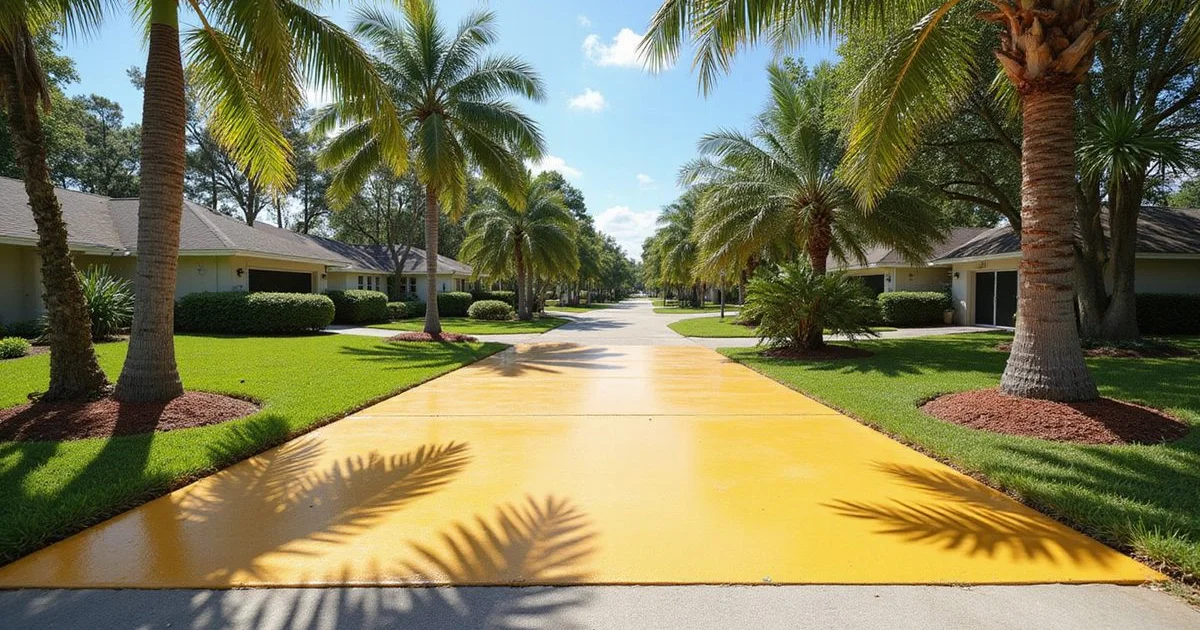
The Florida Sun Problem
You already know that direct sunlight is the harshest test for any exterior surface.
Our team has seen countless projects fail simply because the materials could not handle the constant radiation. Jacksonville averages over 233 sunny days every year with extreme UV index levels hitting 8 to 11.
That intense exposure breaks down weak chemical bonds fast.
For any driveway coating we install in Jacksonville, creating a true UV-resistant surface is the single most critical goal. It dictates whether a surface looks brand new in five years or turns into a chalky mess in just one.
We are going to look at the exact chemical reasons standard products fail outdoors and explore the specific solution that actually survives.
Why Standard Epoxy Fails Outdoors
Standard interior garage epoxy relies on an aromatic chemistry, typically based on Bisphenol A. These aromatic molecules physically cannot withstand ultraviolet light.
Direct sun causes photodegradation. The actual chemical bonds fracture and break apart under the radiation.
On a shaded garage floor, this degradation takes years to become noticeable. Our crews see a completely different story outdoors. Aromatic epoxy exposed directly to the Florida sun on a driveway starts yellowing incredibly fast.
- Yellowing: The clear resin takes on an ugly amber or mustard tint.
- Chalking: The surface turns into a powdery residue as the polymer network breaks down.
- Delamination: The brittle coating loses its bond with the concrete and peels away.
Many homeowners mistake this dusty surface for dirt, but it is actually a total chemical failure. The rapid breakdown is not caused by a defective product or a sloppy installation.
You are simply looking at the wrong chemistry applied in the wrong environment.
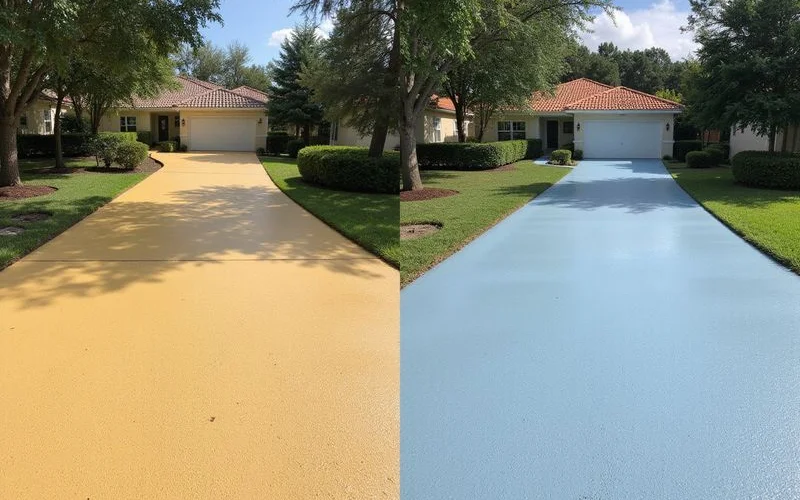
How Aliphatic Polyaspartic Stays Stable
The scientific solution to this problem is aliphatic chemistry. Aliphatic polyaspartic and acrylic-hybrid coatings utilize a completely different molecular structure that resists photochemical breakdown.
Bayer MaterialScience, now known as Covestro, originally developed this advanced chemistry in the 1990s. They needed an industrial coating tough enough to protect steel bridges from extreme weather.
These coatings are genuinely UV-stable and their performance is backed by hard data:
- High Gloss Retention: Materials maintain over 95% of their original shine after 1,000 hours of intense UV exposure during ASTM D4329 laboratory testing.
- Structural Stability: The aliphatic bonds do not fracture or turn chalky under continuous solar radiation.
The same Florida sun that destroys aromatic epoxy in a single season has almost no effect on these advanced resins. An aliphatic polyaspartic driveway holds its vibrant color year after year.
Our installation process relies exclusively on this chemistry. It is the only formula that consistently survives the local climate.
One word decides it
Aliphatic. A driveway coating must be aliphatic chemistry. If it is aromatic, the Florida sun will yellow it, and no amount of install quality can change that.
Color Retention to Expect
Choosing the right material completely changes the lifespan of your exterior surfaces. With a properly applied system, you can expect significantly better performance and long-term value.
Let’s look at the realistic outlook for different materials exposed to direct sunlight.
| Coating Chemistry | Expected Color Retention | Primary Failure Mode |
|---|---|---|
| Aromatic Epoxy (Indoor use only) | 6 months to 2 years | Rapid yellowing and heavy chalking |
| Acrylic Hybrid | 3 to 5 years | Gradual fading and gloss loss |
| Aliphatic Polyaspartic | 8 to 15 years | Extreme UV stability with minimal change |
An aliphatic polyaspartic driveway easily holds its color for a decade or more under direct exposure. The surface will undergo very gradual changes over that span, just like any physical object left outside.
It remains a clean, finished driveway rather than turning into a yellowed, peeling eyesore.
Make a Data-Driven Decision
When you start gathering quotes for a concrete project, you must ask contractors one specific question. Is your system an aliphatic, UV-stable driveway coating?
That single answer reveals whether you are buying a permanent upgrade or a temporary fix.
We stand behind our work by installing only the industrial-grade chemistry proven to last. Contact our team today to schedule an inspection and get a quote for a truly UV-resistant surface.
Questions about your floor?
Real numbers, no pressure — transparent pricing on every system.