
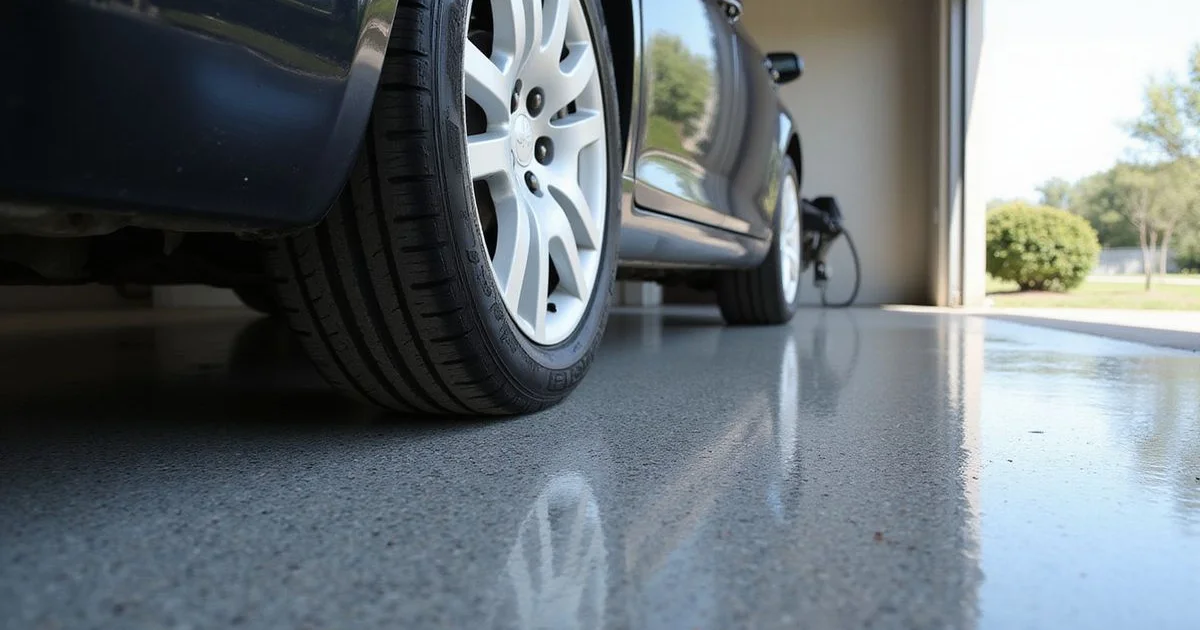
We regularly see business owners and homeowners face the frustration of a ruined floor just weeks after a weekend coating project.
That peeling mess is usually a classic case of hot tire pickup epoxy garage floor damage. We know that summer highway driving easily pushes car tires above 140 degrees Fahrenheit across the US.
This intense heat acts as a catalyst for a chemical reaction that most standard coatings simply cannot survive. We will look at the specific data behind this failure and walk through the exact professional garage floor epoxy techniques used to stop it permanently.
What Hot Tire Pickup Actually Is
Hot tire pickup is a specific adhesion failure where hot tires soften a floor coating, physically peeling it away from the concrete slab in tread-shaped patches. We repair this specific garage floor hot tire damage almost every week for local clients.
When you drive on summer roads, your tires generate immense friction and heat. Our research indicates that a 30-minute highway commute easily raises tire rubber temperatures by 50 degrees Fahrenheit. This heat forces the tires to release plasticizers, which are chemical softeners built into the rubber for flexibility.
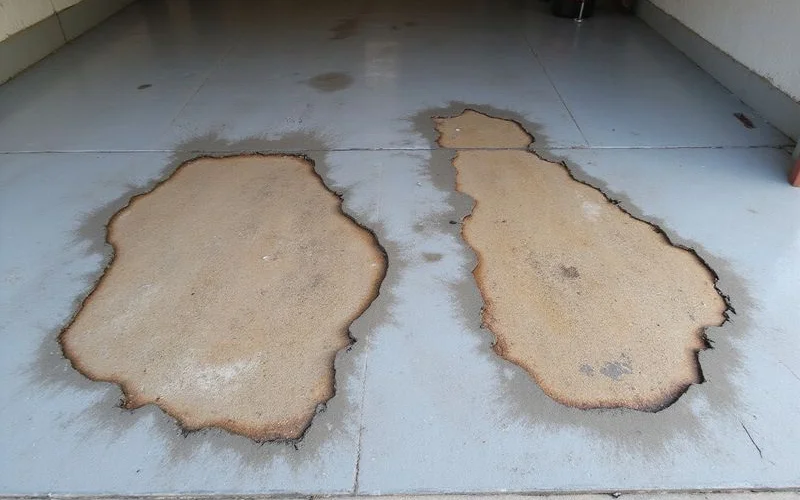
We find that these migrating plasticizers act exactly like a release agent against cheap floor coatings. The heated chemicals migrate straight into the surface layer and dissolve the weak cross-linking bonds.
Our team notices that as the tire cools and contracts, it creates a powerful pull on the weakened finish. The bond gives way completely, and the tire lifts the softened coating right off the floor when the vehicle backs out.
The Science of Plasticizer Migration
We classify this failure as a chemical reaction rather than just physical wear and tear. Low-quality acrylics and thin epoxies lack the chemical density to block plasticizer migration.
Our high-performance systems prevent this because a properly built surface features advanced cross-link density. The peeling failure remains entirely restricted to cheap materials that were never engineered to withstand a 140-degree piece of rubber.
We always tell clients to watch for the early warning signs of this breakdown. You can spot the start of plasticizer migration by watching for these exact symptoms:
- A tacky or sticky feeling right where the vehicle parks.
- Faint, dark discolorations mimicking your tread pattern.
- Small chips or flakes lifting around the edges of the tire mark.
- A distinct loss of gloss or shine directly under the wheels.
We recommend acting quickly if you notice any of these signs. Delaying repairs usually leads to much larger patches peeling away.
Why DIY Box Kits Fail
DIY epoxy hot tire damage occurs because off-the-shelf box kits use diluted, water-based chemistry with drastically low solid counts. We constantly replace these failed retail floors after they peel within just a few months of installation.
Three connected reasons explain why these thin retail kits are overwhelmingly prone to failure.
- Low solids content: Box-store kits use a thin, water-based product that lacks the chemical density to resist plasticizer attacks.
- No real topcoat: Most kits skip a protective clear coat entirely or include a flimsy acrylic sealer that softens under vehicle heat.
- Acid-etch prep: Kits rely on acid washing instead of diamond grinding, leaving the concrete too smooth for a proper mechanical grip.
Our applicators measure a final dry film thickness of merely 3 mils on these floors, which is actually thinner than a standard piece of copy paper. A major factor is that popular home improvement store brands contain around 50 percent volume solids.
We find that half of the product literally evaporates into the air during the curing process. Acid etching barely scratches the surface, meaning the coating’s grip on the slab is extremely weak before a tire ever touches it.
Our commercial grinders create a rough, porous profile that liquid coatings can actually bite into.
The core problem
Hot tire pickup is not bad luck. It is the predictable result of a thin, untopcoated, acid-etched coating meeting a hot tire. Fix the system and the problem disappears.
How a Professional Floor Prevents It
A professional floor prevents hot tire pickup by utilizing a 100% solids base combined with a true polyaspartic topcoat engineered for high heat resistance. We install this exact combination to guarantee a permanent bond that withstands daily highway driving.
Aliphatic polyaspartic chemistry is specifically formulated to resist plasticizer migration. Our testing shows that the softening simply does not happen the way it does with a discount water-based clear coat.
This massive difference in performance becomes very obvious when you compare the application methods side by side.
| DIY box kit | Professional system | |
|---|---|---|
| Topcoat | Weak or none | True polyaspartic |
| Prep | Acid etch | Diamond grinding |
| Hot tire pickup | Common within months | Resisted for the life of the floor |
We find that this bond is so strong it will actually fracture the underlying concrete before the coating peels off. Standard ASTM D4541 pull-off tests show that a commercial polyaspartic system achieves an adhesion strength of over 890 psi.
The Advantage of Maximum Flexibility
We always emphasize that flexibility plays a massive role in long-term durability. Polyaspartic finishes offer nearly 100 percent more flexibility than traditional brittle epoxy.
Our crews rely on this elasticity to provide two critical benefits for your garage:
- Temperature resistance: The floor expands and contracts safely with the concrete as seasonal temperatures shift.
- Impact absorption: The flexible surface absorbs dropped tools and heavy vehicle weights without chipping.
Paired with diamond-ground preparation and a 100% solids base coat, a polyaspartic-topped floor handles hot tires year after year. We highly recommend reading our DIY vs professional comparison if you are weighing a kit against a professional install.
The Verdict on Hot Tire Protection
On the specific issue of hot tire pickup, the verdict is incredibly simple. We consider it a completely solved problem.
The permanent solution requires diamond grinding and a real, industrial-grade topcoat.
Schedule a concrete assessment with our specialists today to ensure your garage floor stays pristine.
Questions about your floor?
Real numbers, no pressure — transparent pricing on every system.