
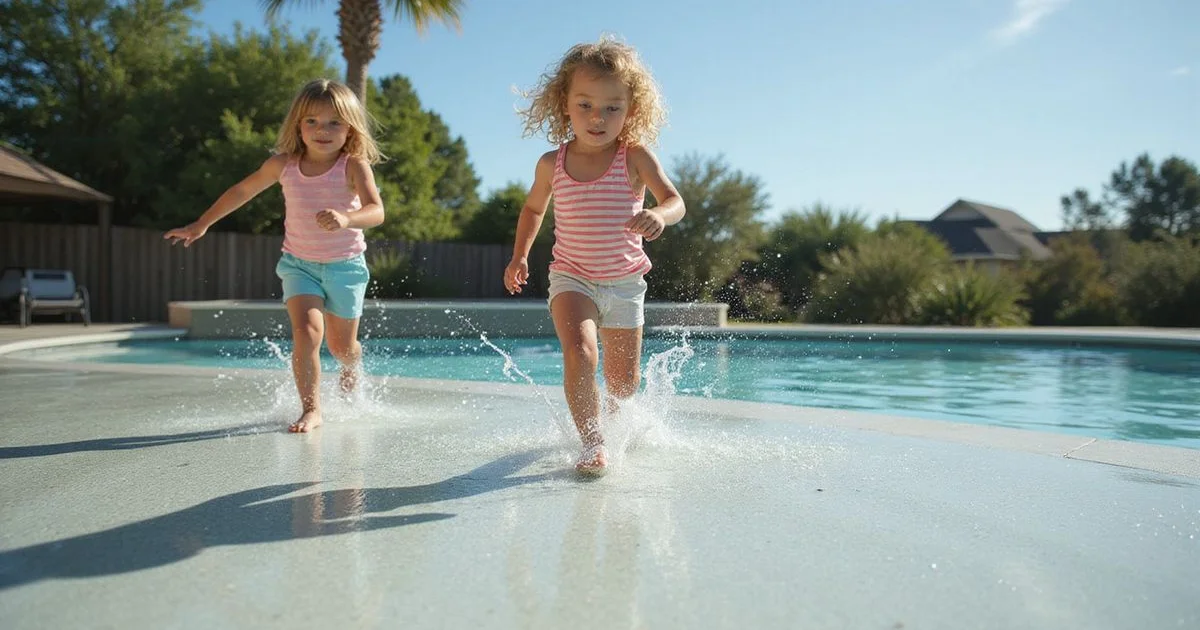
We know that choosing the right surface involves balancing aesthetics with genuine safety concerns. Every summer, slippery U.S. patios lead to countless preventable falls. That hazard is exactly why investing in a slip resistant pool deck coating is the best decision for your backyard.
From what we have seen in the field, a standard concrete slab becomes an ice rink the moment kids start splashing. You can easily prevent this by installing a properly formulated pool deck coating designed specifically for wet environments. Our teams engineer these surfaces to provide reliable traction under the most demanding conditions.
Let us look at the mechanics behind non-slip surfaces and explore the specific safety standards your deck needs to meet.
The Single Most Important Pool Deck Question
A professionally installed epoxy pool deck is highly slip-resistant when wet. Installers achieve this vital safety feature by embedding textured materials directly into the liquid coating.
Our industry experience shows that traction can’t be an afterthought when dealing with standing water. The U.S. Centers for Disease Control and Prevention reports thousands of pool-related injuries annually, and slick perimeter surfaces play a massive role in those statistics. Bare concrete and standard pavers lose significant friction the second they get wet.
The good news is that slip resistance is a completely solved problem in modern surface engineering. We build a specialized micro-texture into the base layer so the final product naturally grips bare feet. It doesn’t happen by accident. Safety is a deliberate structural choice.
How Aggregate Broadcast Works
Aggregate broadcast works by scattering thousands of tiny, hard particles across a wet epoxy layer before it hardens. This process permanently locks the grit into the floor to create a durable micro-texture.
What makes a non slip pool deck truly safe is this exact broadcast technique. A smooth, glossy coating with nothing added would be dangerously slippery.
While the base coat is still fluid, technicians apply the fine aggregate evenly across the entire patio. It cures overnight and gives bare feet, wet shoes, and paws something solid to grip. We carefully select the aggregate type based on your specific traffic levels and comfort preferences.
Popular Non-Slip Aggregate Options
- Aluminum oxide: This remarkably hard, 60-grit aggregate provides strong grip for heavy commercial use and U.S. public pool safety.
- Silica sand: Installers often utilize 20-40 mesh size quartz sand for an economical, highly effective broadcast that handles daily residential wear.
- Shark grip: This micronized polymer additive creates a much more subtle texture that feels softer on sensitive skin.
Our installation technicians tune the broadcast density to match the exact way your family uses the space. This ensures the surface remains exceptionally grippy when wet but still comfortable underfoot.
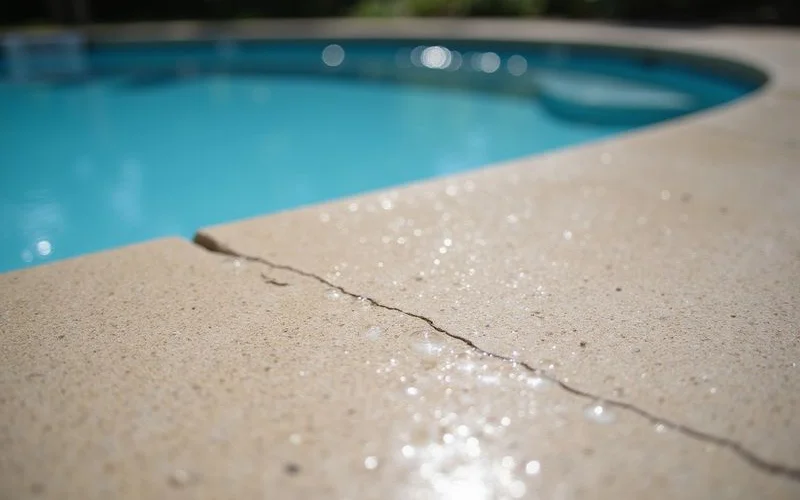
Plan it in from the start
Aggregate must be broadcast into wet coating during installation. It cannot be added later. Slip resistance is a design decision made before the project begins, not a finishing touch.
Measuring Safety: Coefficient of Friction
Professionals measure wet pool deck safety using the Dynamic Coefficient of Friction, or DCOF. The higher the wet DCOF rating, the more traction and safety the deck provides.
We rely on strict national benchmarks to evaluate every surface we pour. The American National Standards Institute (ANSI) A326.3 standard requires a minimum wet DCOF of 0.42 for level interior floors.
An outdoor U.S. pool deck faces much harsher conditions. Industry best practices recommend hitting a wet DCOF of 0.55 or higher for exterior surfaces exposed to standing water. A pool deck must comfortably exceed standard indoor thresholds to protect running children and active adults.
| Surface Type | Wet Traction Quality | Typical DCOF Rating |
|---|---|---|
| Smooth coated deck, no aggregate | Poor, extremely slick | Below 0.30 |
| Bare broom-finished concrete | Variable, degrades over time | 0.35 to 0.45 |
| Coated deck with aggregate broadcast | Good, consistently safe | 0.55 or higher |
Our team tests these variables to guarantee your new patio hits that 0.55 target mark easily. You get a measurable, documented layer of security instead of just a visual upgrade.
Safe for Everyone Who Uses the Deck
A properly aggregated pool deck delivers confident traction for everyone from sprinting toddlers to seniors moving with a walker. Safety depends on protecting the specific people and pets who enjoy your backyard.
We know that pets don’t think about footing at all when they chase a ball toward the water. Kids are equally distracted by summer fun. Providing a textured, high-friction barrier gives all of them a secure foundation, whether the concrete is soaked or bone dry.
Customizing Your Surface Profile
When you book a coating evaluation, tell us exactly how the space functions on a daily basis. An active household with small children requires a different grip profile than a quiet patio used mostly for adult sunbathing.
- High-Traffic Zones: Installers increase the aggregate density near diving boards and ladders.
- Lounge Areas: A lighter broadcast keeps the floor smooth under delicate lounge chairs.
- Step Edges: Technicians apply extra grit along stair treads to prevent dangerous missteps.
Our team will specify the exact mesh size and material to match your lifestyle. Reach out to schedule a consultation, and let us evaluate your patio for a safer summer. Keeping your family safe is the absolute standard, and it is the whole point of our work.
Questions about your floor?
Real numbers, no pressure — transparent pricing on every system.