
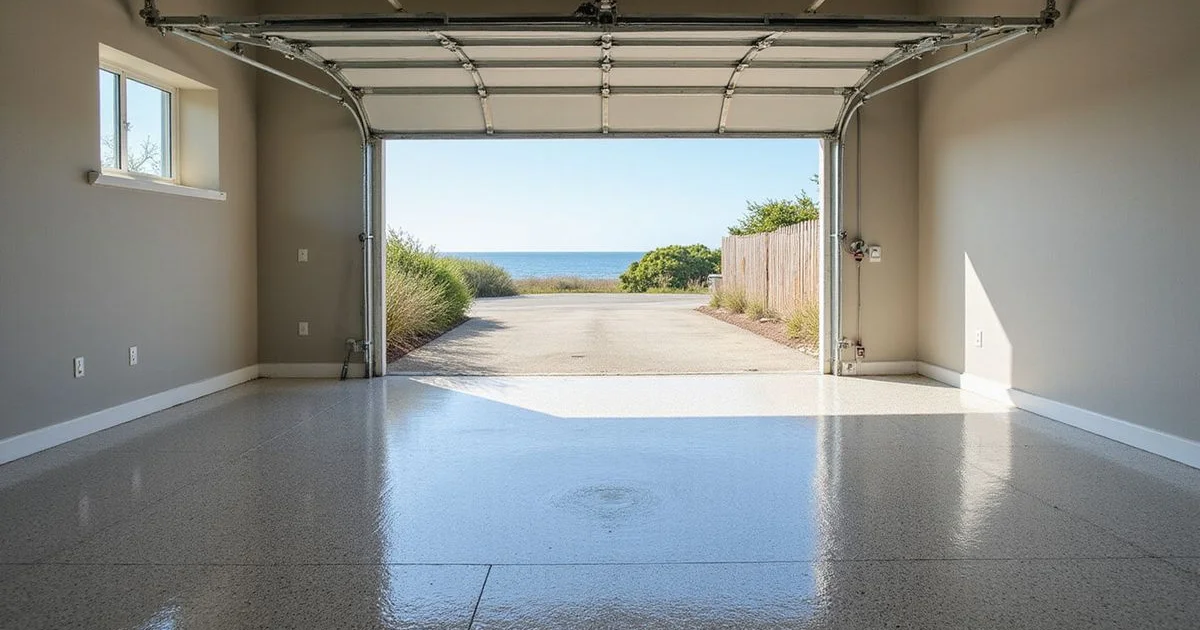
Why a Beach Garage Is a Different Job
A beach garage requires a specialized coating because ocean air pushes chloride particles deep into the concrete. Standard systems cannot withstand this relentless chemical attack.
Any contractor working along the Florida coast knows that humidity and ocean spray change the rules of concrete protection. You have probably noticed how quickly untreated surfaces degrade right off the A1A corridor.
Our teams see this difference constantly when evaluating properties near the ocean. The environmental factors driving this rapid degradation include:
- Constant exposure to relative humidity exceeding 70 percent.
- Continuous deposits of microscopic airborne salt.
- Accelerated chloride ion migration through porous materials.
We know a garage three miles inland and a garage three blocks from the water might look identical on the surface. The reality is they represent completely different environments. Coastal Jacksonville garages face a relentless stress that inland neighborhoods never experience.
This invisible chloride penetration directly attacks the coating’s bond from underneath.
Our standard garage floor epoxy system is the right choice across most of the city. A beach property requires a completely different topcoat. Treating a coastal property like an inland one guarantees a premature failure.
We always warn clients that this oversight is the most common reason coatings fail near the water. Installing a dedicated salt air garage floor coating jacksonville beach system accounts for this geographic reality. Let’s break down exactly what happens to a coastal slab and outline the precise installation methods required.
What Salt Air Does to a Garage Floor
Salt air destroys garage floors by depositing chloride particles that crystallize inside the concrete. These expanding crystals pry the material apart and destroy the bond line where a standard coating attaches.
We encounter this specific damage profile on nearly every unprotected coastal slab. Concrete is naturally a highly porous material.
The Mechanics of Salt Weathering
Ocean air carries microscopic chloride particles that settle continuously on the surface. Moisture then draws these destructive particles deep into the slab.
Our inspections reveal that as moisture evaporates, the salt crystallizes inside the pore structure. These expanding crystals pry the concrete apart from within.
This destructive cycle is a well-documented process called salt weathering. Industry data from 2026 shows that repairing concrete spalling costs an average of $4 to $8 per square foot.
The Threat to the Bond Line
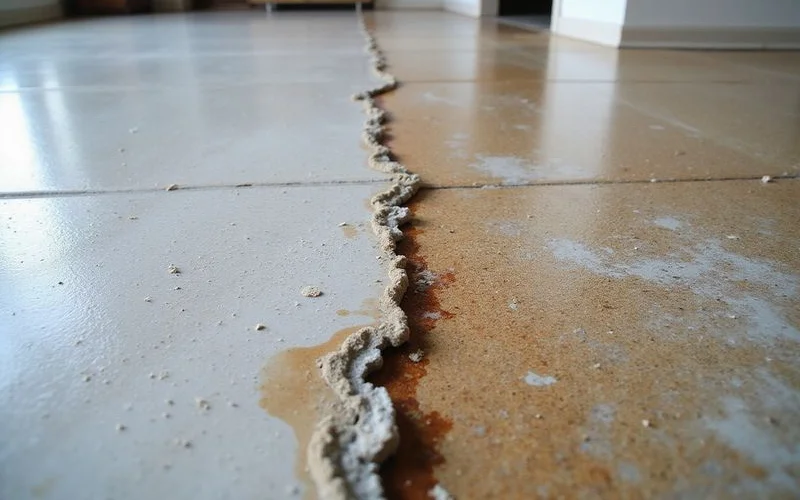
We urge property owners to take preventative action before facing these expensive structural repairs. For a coated floor, the worst damage concentrates exactly at the bond line.
This line is the vulnerable interface where the coating meets the concrete. Salt and moisture keep migrating through the slab even after a standard topcoat is applied. These trapped chlorides collect right at that interface and break the chemical adhesion.
Our companion guide on salt air and concrete covers the underlying science in more depth. Standard topcoats simply lack the formulation to hold their bond against that chemistry. Coastal failures typically show up as severe edge lifting and blistering.
The coastal rule of thumb
Within three miles of the ocean, you must ask for a salt-air-rated system by name. It is never an optional upgrade. This specific chemistry is the only difference between a floor that lasts decades and one that peels within months.
The Salt-Air-Rated System
The salt-air-rated system uses deep mechanical grinding to remove contaminated concrete. This is followed by a marine-grade polyaspartic topcoat.
We build this coastal garage epoxy system differently in two critical areas to ensure permanent adhesion. The process requires a much more aggressive approach than standard applications.
Extra Surface Removal
Our installation crews go far beyond normal diamond grinding for these beach properties. Specialized equipment removes the entire salt-saturated surface layer of the existing slab.
This critical step ensures the new coating bonds strictly to sound, uncontaminated concrete. Deeper spalling always gets patched with high-strength structural mortars.
Skipping this step guarantees that existing chlorides remain trapped under the new floor. A compromised base will ruin even the best topcoat.
Marine-Spec Topcoat Chemistry
We utilize a highly modified aliphatic polyaspartic engineered specifically to resist chloride attack. This marine-spec chemistry protects the vulnerable bond line far better than standard inland formulations.
Laboratory testing shows these premium polyaspartic coatings achieve tensile strengths exceeding 4,000 psi. They create an impenetrable barrier against coastal moisture.
| Feature | Standard system | Salt-air-rated system |
|---|---|---|
| Surface prep | Standard diamond grinding | Heavy grinding plus salt-layer removal |
| Topcoat formulation | Standard polyaspartic resin | Marine-spec chloride-resistant polyaspartic |
| Tensile strength | Standard domestic ratings | Exceeds 4,000 psi for maximum durability |
| Recommended zone | Inland Jacksonville | Within 3 miles of the coast |
Neighborhoods We Serve
We install specialized coastal coatings throughout all major beach communities to ensure your property withstands the harsh Atlantic climate. A coastal-rated install gives a beach house garage floor the exact defense it needs to survive its address.
Our team routinely upgrades properties up and down the A1A corridor. This service area includes:
- Jacksonville Beach
- Neptune Beach
- Atlantic Beach
- Ponte Vedra Beach
We handle everything from completely bare, new concrete to older slabs already showing severe salt scaling. The coastal environment demands proactive maintenance before spalling causes permanent structural damage.
Our process guarantees an impenetrable finish regardless of the initial slab condition. Book a free on-site estimate today and specifically ask for the coastal system.
Protecting your investment starts with one simple phone call. Local homeowners depend on this proven application to stop chloride damage permanently.
Questions about your floor?
Real numbers, no pressure — transparent pricing on every system.