Coastal Salt-Air-Rated Topcoats: What Beach-Area Garages Actually Need
Why standard epoxy topcoats fail within a few miles of the ocean, what marine-spec aliphatic polyaspartic chemistry does differently, and how Jacksonville Beach, Neptune, Atlantic, and Ponte Vedra homeowners should spec a garage floor.
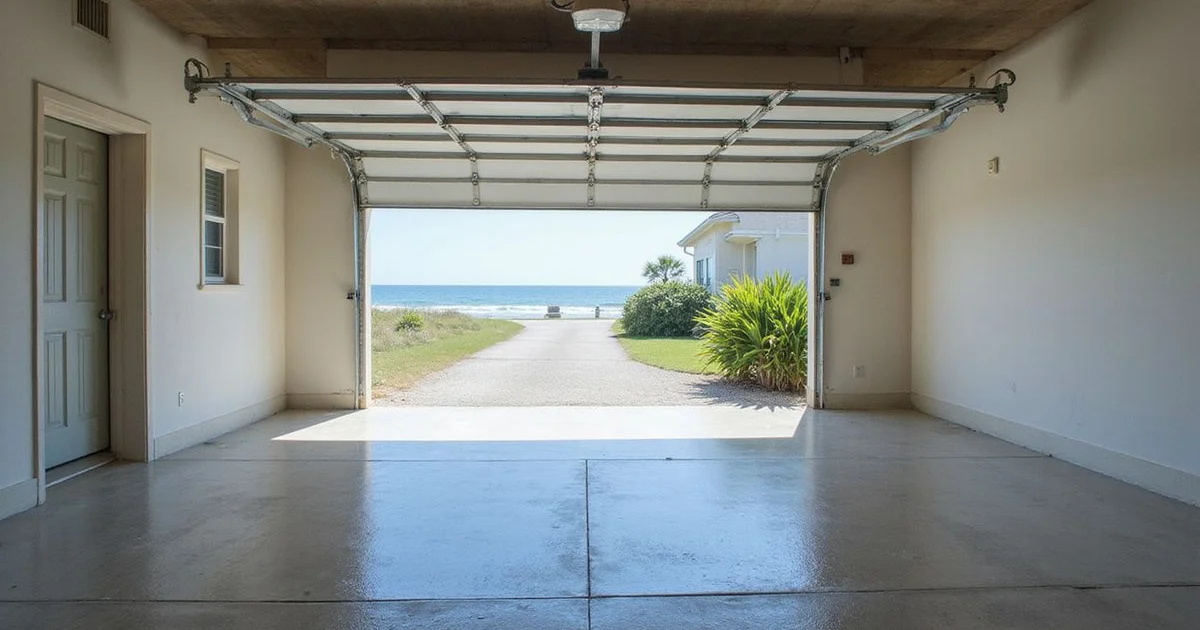
If your home sits within about three miles of the ocean — Jacksonville Beach, Neptune Beach, Atlantic Beach, Ponte Vedra — your garage floor lives in a different chemical environment than a garage in Mandarin or Orange Park. Here’s what salt air actually does to concrete and coatings, and what “coastal-rated” should mean when an installer says it.
What salt air does to a garage floor
Airborne chlorides settle on every surface near the coast, and they’re hygroscopic — they pull moisture out of Florida’s humid air and hold it against the slab. On bare concrete, that drives salt crystallization inside the pores: the visible result is scaling, pitting, and that powdery surface breakdown beach-area homeowners know well. On coated concrete, chlorides attack at the weakest point — the bond line — which is why cheap coatings near the beach often fail by delaminating in sheets rather than wearing through.
Why standard topcoats aren’t enough here
A typical garage system is an epoxy base under a polyaspartic or polyurethane topcoat. The base coat chemistry matters less to salt exposure than the topcoat, because the topcoat is the barrier. Standard topcoats are formulated for UV stability and abrasion — fine inland, incomplete at the beach. Marine-spec aliphatic polyaspartic formulations add higher cross-link density and chloride resistance: a tighter molecular film that salt-laden moisture can’t migrate through. The same class of chemistry is used on bridge decks and marine structures for exactly this reason.
What to spec if you’re near the coast
Three requirements separate a beach-ready floor from an inland spec. First, the topcoat must be an aliphatic (not aromatic) polyaspartic rated for chloride exposure. Second, surface prep must be mechanical diamond grinding — salt-damaged slabs need the compromised surface layer ground off, not etched over. Third, moisture testing matters even more than inland, because coastal slabs frequently read high on vapor emission and need a barrier primer under the system.
Cost-wise, expect the coastal topcoat spec to add modestly to a standard install — see our published garage floor pricing for baselines, or read the deeper dive on protecting beachside Jacksonville floors from salt air.
The bottom line
“Epoxy is epoxy” is a false statement everywhere, but it’s an expensive false statement at the beach. If you’re getting quotes for a garage floor east of the Intracoastal, make every bidder answer one question: what specifically in your topcoat spec is rated for chloride exposure? An installer who can’t answer it is quoting you an inland floor for a coastal house.
Jacksonville Epoxy Flooring Team
The Jacksonville Epoxy Flooring team researches and writes practical guides on epoxy and concrete coating systems for Northeast Florida homes and businesses.